
Every sound your violin makes is controlled by just three things. Change any one of them and the sound transforms completely. This is the Sound Formula — and once you understand it, you control your instrument.
In Learn Violin Fast — Book 2, I break down exactly how to manipulate sound with the bow using a simple, practical formula. Here’s the complete guide.
How Do We Create Meaning with Sound?
Before we talk about the bow, let’s talk about why sound manipulation matters.
Think about how you speak. When you’re happy, you speak quickly, loudly, and with a higher pitch. When you’re sad, you speak slowly, quietly, and with a lower pitch. When you’re irritated, you use short, accented words.
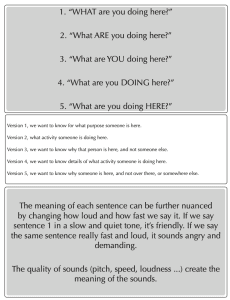
Music works the same way. The quality of sounds — pitch, speed, loudness — creates meaning. Playing the violin isn’t just about hitting the right notes. It’s about making those notes say something.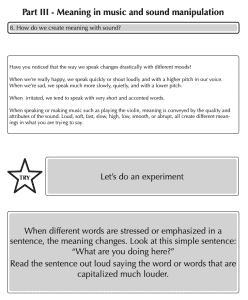
The Sound Formula
Producing beautiful sound on a violin isn’t magic. It’s physics. The sound your violin produces is a result of three elements:
Sound = Bow Resistance × Bow Distance × Bow Speed
That’s it. Three variables. By changing these elements, you change the sound completely.
Think of each element on a scale of 1–10, where 1 is the least and 10 is the most.
Example — Playing Twinkle Twinkle softly (piano):
Sound = 3 Bow Resistance × 5 Bow Distance × 5 Bow Speed
Example — Playing Twinkle Twinkle loudly (forte):
Sound = 7 Bow Resistance × 10 Bow Distance × 7 Bow Speed
See the difference? More of everything = louder. Less = softer. But it’s not just about volume — different combinations create completely different tonal colors.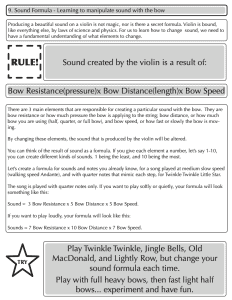
Element 1: Bow Resistance (Pressure)
The bow is a spring under tension. When the bow pushes on the string, the string pushes back — Newton’s third law. We call this interaction bow resistance or bow pressure.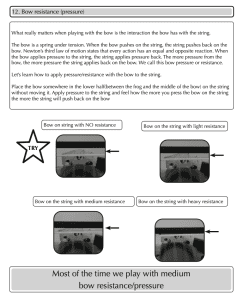
How to Feel Bow Resistance
- Place the bow somewhere in the lower half (between frog and middle) on a string
- Don’t move the bow — just press down
- Feel how the string pushes back against the bow
- Apply more pressure — feel more pushback
- Apply less — feel less
Most of the time, we play with medium bow resistance. Too much pressure creates a scratchy, crushed sound. Too little creates a wispy, airy sound.
Element 2: Bow Speed
Here’s a concept that confuses many beginners: to play with a faster bow, you must use LESS effort and LESS muscle tension.
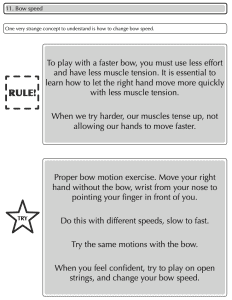 This seems backwards. When we try harder at something, our muscles tense up. But tense muscles are slow muscles. To move the bow faster, you need to relax your arm and let it move freely.
Bow Speed Exercise
- Move your right hand without the bow — wrist motion from your nose to pointing your finger in front of you
- Do this at different speeds — slow to fast
- Notice: faster = more relaxed, not more tense
- Now try the same motions with the bow
- When confident, play on open strings and change your bow speed
Element 3: Bow Distance
Bow distance is how much of the bow you use — not how fast you move it. You can play with:
- Full bow — from frog to tip (maximum distance)
- Half bow — upper half or lower half
- Quarter bow — small sections
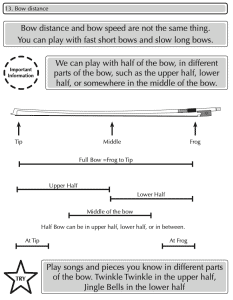 Bow distance and bow speed are NOT the same thing. You can play:
- Fast short bows (fast speed, small distance)
- Slow long bows (slow speed, full distance)
- Fast full bows (fast speed, full distance)
Each combination creates a different sound and musical effect.
Practice Exercise
Play songs you know using different parts of the bow:
- Twinkle Twinkle in the upper half
- Jingle Bells in the lower half
- A scale using full bows
Bow Distribution
Bow distribution refers to which part of the bow a certain note or passage is played on. As a general rule:
- Long notes get full bows
- Shorter notes get half bows or less
- Loud passages use more bow (larger distance)
- Soft passages use less bow (smaller distance)
Focus your attention on the bow and watch where you play. Many beginners play entire pieces in just one small section of the bow — usually the middle. Train yourself to use the whole bow when the music calls for it.
The Professional Bow Hold
Once you’re comfortable with the beginner bow hold (thumb on the silver), it’s time to upgrade to the professional bow hold. This gives you much more control and better sound.
The key change: move your thumb from the silver to next to the frog.
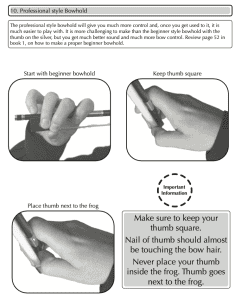 Important details:
- Keep your thumb square — not bent or collapsed
- The nail of your thumb should almost touch the bow hair
- Never place your thumb inside the frog — it goes next to it
The professional bow hold is harder to make at first, but gives you much better sound and bow control once you get used to it.
Sound Formula Cheat Sheet
| Want This Sound? | Bow Resistance | Bow Distance | Bow Speed |
|---|---|---|---|
| Loud (forte) | High (7–8) | Full bow (9–10) | Fast (7–8) |
| Soft (piano) | Low (2–3) | Half bow (4–5) | Medium (4–5) |
| Powerful accent | High burst (9) | Short (3–4) | Fast burst (9) |
| Gentle, singing | Medium (5) | Full bow (8–9) | Slow (3–4) |
| Whisper | Very low (1–2) | Small (2–3) | Slow (2–3) |
Practice Exercises
Try these with pieces you already know:
- Play Twinkle Twinkle — first softly (low formula), then loudly (high formula)
- Play Jingle Bells — upper half only, then lower half only, then full bow
- Play a D scale — slow full bows with medium pressure, focusing on even tone
- Experiment freely — fast light half bows, slow heavy full bows, and everything in between
Use the Power of 10 — try each combination 10 times.
Get the Full Method
This guide covers the Sound Formula basics, but Learn Violin Fast — Book 2 includes the complete system with dozens of exercises for each element, dynamics (forte and piano), crescendo and diminuendo, accents, tenuto, and pieces that put it all together.
👉 Get Learn Violin Fast — Book 2 on Amazon — master bow control, sound production, and musical expression with step-by-step exercises.
🎬 Subscribe to Violin Explained on YouTube for video demonstrations of the Sound Formula in action.
Written by Sergei Panov, author of the Learn Violin Fast method book series and founder of ViolinExplained.com. Sergei has taught over 1,000 violin students and developed this method to help beginners learn as quickly and enjoyably as possible.