Posted on Leave a comment

Violin Finger Placement: Where Exactly Do Your Fingers Go?

Knowing exactly where to place your fingers on the violin is one of the biggest challenges for beginners. Unlike a guitar with frets or a piano with keys, the violin fingerboard is completely smooth — there’s nothing to tell you where to press.

That’s why in Learn Violin Fast — Book 1, I teach every student to start with tape markers on the fingerboard. These tapes act as visual guides that show you exactly where each finger goes — and they work incredibly well.

Where Do You Put Your Fingers on a Violin?

Place tape markers on the fingerboard at specific measured distances from the nut, then assign one finger per tape: index finger on tape 1, middle finger on tape 2, ring finger on tape 3, and pinky on tape 4.

Let me walk you through the complete system.

Finger Numbering on the Violin

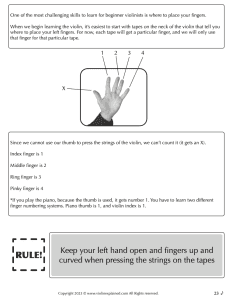
Since we can’t use our thumb to press the strings (it supports the neck), violin fingers are numbered differently than you might expect:

  • Index finger = 1
  • Middle finger = 2
  • Ring finger = 3
  • Pinky finger = 4
  • Thumb = X (not used on the strings)
  • Open string = 0 (no fingers pressing)

If you play piano, note that piano starts with thumb as 1. On violin, the index finger is 1. These are two different systems!Image showing how we name fingers that we use on the violin
The Tape Trick Every Beginner Needs

Tapes on the fingerboard are the single best tool for learning finger placement. Each tape marks where a specific finger should press the string.

Why tapes work:

  • They give you a visual target to aim for
  • They help you play in tune from the start
  • They build muscle memory so your fingers learn the distances
  • They work on every string — the same tape positions apply to all four strings

The Rule:

For now, each tape gets one specific finger, and you only use that finger for that tape:

  • Tape 1 → Index finger (1)
  • Tape 2 → Middle finger (2)
  • Tape 3 → Ring finger (3)
  • Tape 4 → Pinky (4)

Why Are the Tapes Placed Where They Are?

This is the science behind the tape positions — and understanding it helps you play in tune.

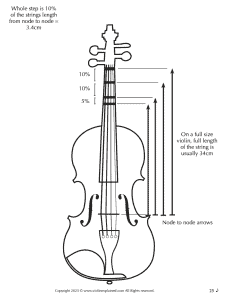
The distance between tapes is based on whole steps and half steps:

  • A whole step = 10% of the string’s length from nut to bridge
  • A half step = 5% of the string’s length

This is why:

  • Tapes 1 and 2 are far apart — they’re a whole step (big step)
  • Tapes 2 and 3 are close together — they’re a half step (small step)

Did you notice that the distances between tapes get smaller as you go higher? That’s because each time you press a finger down, the remaining string gets shorter. As a result, 10% of a shorter string is a smaller distance. This is why higher positions on the violin have fingers closer together.Image of violin diagram showing distances and percentages of where the tapes on the violin go
Exact Tape Measurements

If you need to add tapes to your violin, here are the exact measurements from the nut for each violin size:

Full Size (4/4) Violin:

Tape Distance from Nut
Tape 1 34mm (1 3/8 inches)
Tape 2 66mm (2 5/8 inches)
Tape 3 80mm (3 1/8 inches)
Tape 4 106mm (4 1/8 inches)

3/4 Size Violin:

Tape Distance from Nut
Tape 1 32mm (1 1/4 inches)
Tape 2 61mm (2 3/8 inches)
Tape 3 75mm (2 7/8 inches)
Tape 4 100mm (3 7/8 inches)

1/2 Size Violin:

Tape Distance from Nut
Tape 1 28mm (1 1/8 inches)
Tape 2 54mm (2 1/8 inches)
Tape 3 68mm (2 5/8 inches)
Tape 4 91mm (3 5/8 inches)

1/4 Size Violin:

Tape Distance from Nut
Tape 1 25mm (1 inch)
Tape 2 48mm (1 7/8 inches)
Tape 3 60mm (2 3/8 inches)
Tape 4 79mm (3 1/8 inches)

How to Apply Tapes:

  1. Cut a piece of tape about 1.5 to 2 inches long
  2. Slide it under the strings but on top of the fingerboard
  3. Place it at the correct measurement from the nut
  4. You can mark positions with a pencil first

Best tape to use: 1/8 inch color vinyl pinstripe tape. It’s easy to handle, doesn’t rub off, and is easy to remove and change. Avoid paper stickers or duct tape — they leave sticky residue and absorb dirt.

What Note Does Each Finger Make?

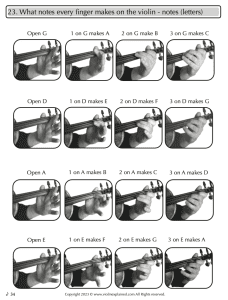
Here’s the complete finger-to-note chart for all four strings:

String Open (0) Finger 1 Finger 2 Finger 3
G G A B C
D D E F G
A A B C D
E E F G A

Picture that show and connect violin, left fingers, and what notes they make.The Pattern:

  • Add a finger = add a note (next letter in the alphabet)
  • Subtract a finger = subtract a note (previous letter)
  • After G, repeat back to A (there is no H note in music!)

So if you know the open string name, you can figure out every note. For example: Open D → add finger 1 → E → add finger 2 → F → add finger 3 → G

Proper Left Hand Technique

Placing your fingers correctly isn’t just about where — it’s also about how:

The Rules:

  1. Keep your left hand open — your wrist should NOT touch the violin’s neck
  2. Fingers up and curved — press with your fingertips, not flat fingers
  3. Your whole hand doesn’t have to squeeze — only your fingertip needs to press the string
  4. Wrist at 180 degrees — a straight line from elbow to hand, no bending in or out
  5. Knuckle and thumb support the violin — they’re the anchor points

Pictures showing proper left hand positions on the violinShoulder Awareness:

When we do difficult tasks, our shoulders tend to tense up. A raised shoulder limits your movement and causes pain.

Pay attention to what your shoulder is doing while you play, and remind it to stay relaxed and down.

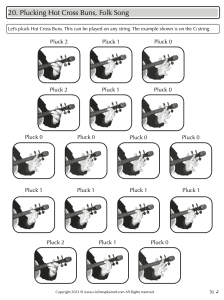
Your First Song with Fingers: Hot Cross Buns

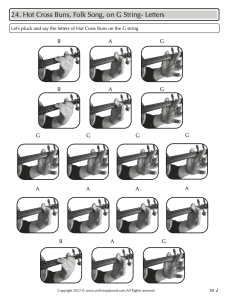
Once you know your finger numbers and tape positions, you can play your first song! Hot Cross Buns uses only fingers 0, 1, and 2.

On the D string:

2  1  0  |  2  1  0  |  0 0 0 0  1 1 1 1  |  2  1  0  ||
F  E  D     F  E  D     D D D D  E E E E     F  E  D

On the A string:

2  1  0  |  2  1  0  |  0 0 0 0  1 1 1 1  |  2  1  0  ||
C  B  A     C  B  A     A A A A  B B B B     C  B  A

Practice tip: Pluck and say the finger number out loud, then pluck and say the note letter. This builds the connection between fingers and notes.Pictures of how to play Hot Cross Buns on Violin, holding the violin guitar style
When to Remove the Tapes

This is the question every beginner asks. Here’s the answer:

Remove tapes when you can consistently play in tune without looking at them.

Signs you’re ready:

  • You can play scales and songs while looking at your bow (not your left hand)
  • Your fingers naturally land in the right spots
  • You can hear when a note is out of tune and correct it

For most students, this takes several weeks to a few months. There’s no rush — the tapes are a tool, not a crutch. Even some advanced students keep tape 1 as a reference point.

Common Finger Placement Mistakes

Mistake Fix
Flat fingers (pressing with pads) Curve your fingers — press with fingertips
Wrist touching the neck Keep wrist straight at 180° — the “open hand”
Squeezing too hard Only your fingertip needs to press — relax the rest
Fingers landing between tapes Aim for the center of each tape
Not lifting unused fingers Keep fingers hovering above the string, curved and ready
Raised/tense shoulder Consciously relax and drop your shoulder

Practice Checklist

Use the Power of 10 — do each task 10 times:

  • Press each finger (1, 2, 3) on the G string and pluck — say the finger number
  • Repeat on D, A, and E strings
  • Say the note letter for each finger on each string (use the chart)
  • Play Hot Cross Buns on D string from memory
  • Play Hot Cross Buns on A string from memory
  • Check: Is your hand open? Fingers curved? Wrist straight? Shoulder down?
  • Play a D scale: Open D → 1 → 2 → 3 → Open A → 1 → 2 → 3

Get the Full Method

This guide covers the finger placement basics, but Learn Violin Fast — Book 1 includes the complete system — tape measurements for all violin sizes, finger-to-note charts, exercises for every string, quizzes, scales, and 8 songs that progressively build your finger skills.

👉 Get Learn Violin Fast — Book 1 on Amazon — the complete beginner method with step-by-step diagrams, exercises, and songs.

🎬 Subscribe to Violin Explained on YouTube for video demonstrations of finger placement and tape application.


Written by Sergei Panov, author of the Learn Violin Fast method book series and founder of ViolinExplained.com. Sergei has taught over 1,000 violin students and developed this method to help beginners learn as quickly and enjoyably as possible.
Posted on Leave a comment

Your First Day with a Violin: What to Do (and What NOT to Do)

Your first day with a violin should be exciting, not overwhelming. The key is knowing exactly what to focus on — and what to skip for now.

After teaching over 1,000 students their very first violin lesson, I designed the Learn Violin Fast method to make Day 1 as productive and fun as possible. Here’s the exact roadmap I use.

What Should You Do on Your First Day with a Violin?

Start by learning how the violin makes sound, hold it guitar-style, and pluck your first notes — don’t try to use the bow or play on your shoulder yet.

Most beginners make the mistake of trying to do everything at once. However, the Learn Violin Fast method breaks your first day into manageable steps that build on each other.

Before You Play: Understand Your Instrument

Before you make a single sound, take 5 minutes to understand what you’re holding. This isn’t boring theory — it’s the foundation that makes everything else click faster.

What Is Music?

At its core, music is organized sound. Sound is created by vibrations — changes in air pressure. The violin’s job is to produce and amplify those vibrations into beautiful music.

How Does the Violin Make Sound?

There are two ways to make sound on a violin:

  1. Plucking (pizzicato or pizz.) — pulling the string with your finger
  2. Bowing (arco) — drawing the bow across the string

Both methods vibrate the string, which vibrates the body of the violin, which moves the air inside — and that’s the sound you hear.

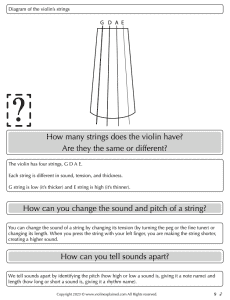
Know Your Four Strings

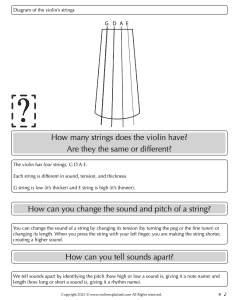
The violin has four strings: G, D, A, E

  • G string = lowest, thickest
  • D string = second lowest
  • A string = second highest
  • E string = highest, thinnest

You can change a string’s pitch by:

  • Turning the peg or fine tuner (changes tension)
  • Pressing with your left finger (changes string length = higher pitch)Image shows diagram of violins four strings G D A E

Know the Parts of Your Violin

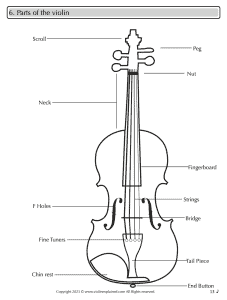
Before playing, identify these key parts on your own instrument:

  • Scroll — the decorative spiral at the top
  • Pegs — turn these to tune (carefully!)
  • Nut — holds the strings at the top of the neck
  • Neck — where your left hand goes
  • Fingerboard — where you press your fingers to change notes
  • Bridge — the wooden piece that holds the strings up and transfers vibrations
  • Fine tuners — small screws at the bottom for precise tuning
  • Chin rest — where your chin rests when playing on the shoulder
  • Tailpiece — secures the strings and fine tunersDiagram of Violin and all the parts labeled

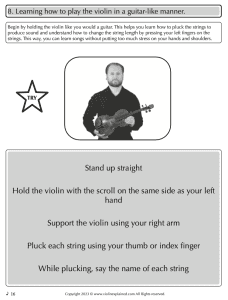
Step 1: Hold the Violin Guitar Style

Here’s the secret that makes Day 1 so much easier: don’t put the violin on your shoulder yet.

Start by holding it like a guitar. This lets you:

  • Learn to pluck and make sounds immediately
  • Understand finger placement without strain
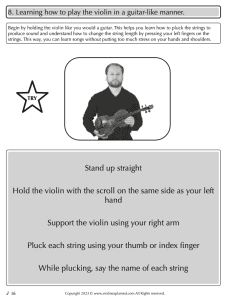
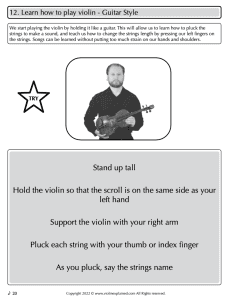
  • Play your first song within minutesImage showing how to hold violin like a guitar

How to hold it:

  1. Stand up straight
  2. Hold the violin with the scroll on the same side as your left hand
  3. Support the violin using your right arm
  4. Pluck each string with your thumb or index finger
  5. Say the name of each string as you pluck: G, D, A, E

Step 2: Learn Rhythm Basics

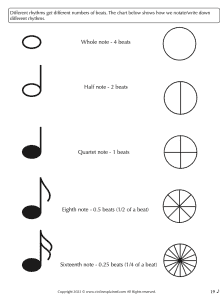
Before playing a song, you need to understand rhythm — how long each note lasts.

Diagram of different note lengthsTry this right now:

  • Walk at a medium-slow pace and stomp your feet at the same speed
  • That steady beat is your tempo

Now apply it to the violin:

Action What You’re Playing
Pluck a string, count to 4 Whole note
Pluck a string, count to 2 Half note
Pluck a string, count to 1 Quarter note
Pluck twice as fast Eighth notes

That’s it — you just learned the four basic rhythms!

Step 3: Learn Your First Finger Numbers

Since we can’t use our thumb to press violin strings, the fingers are numbered differently:

  • Index finger = 1
  • Middle finger = 2
  • Ring finger = 3
  • Pinky finger = 4
  • Thumb = X (not used on the strings)

Piano players note: on piano, the thumb is 1. On violin, the index finger is 1. You’ll need to learn both systems!

The Rule: Keep your left hand open and fingers up and curved when pressing the strings on the tapes.Image showing how we name fingers that we use on the violin

Step 4: Play Your First Song — Hot Cross Buns

Yes, you can play a song on your very first day! Hot Cross Buns uses only three notes and is the perfect first piece.

On the D string:

2  1  0  |  2  1  0  |  0 0 0 0  1 1 1 1  |  2  1  0  ||
F  E  D     F  E  D     D D D D  E E E E     F  E  D
  • 0 = open string (no fingers)
  • 1 = index finger on first tape
  • 2 = middle finger on second tape

Pluck each note and say the finger number (or letter) out loud. Use the Power of 10 — play it 10 times to start memorizing it.Photos of how to play hot cross buns on a violin, holding violin like a guitar

Step 5: Learn What Notes Your Fingers Make

Here’s the magic connection — each finger on each string makes a specific note:

String Open (0) Finger 1 Finger 2 Finger 3
G G A B C
D D E F G
A A B C D
E E F G A

The pattern: Add a finger = add a note (next letter). Subtract a finger = subtract a note. After G, repeat back to A (there is no H note in music).Picture that show and connect violin, left fingers, and what notes they make.

What NOT to Do on Day 1

These are the 6 most common mistakes I see beginners make on their first day:

❌ Don’t Do This ✅ Do This Instead
Try to play on your shoulder immediately Start guitar style — build comfort first
Pick up the bow on Day 1 Focus on plucking — the bow comes later
Squeeze your left hand Keep fingers curved and relaxed
Tense your shoulders Remind your shoulders to stay down and relaxed
Try to learn everything at once Focus on open strings, then fingers, then one song
Get frustrated if it sounds bad Every violinist sounded bad on Day 1 — it gets better fast

Your Day 1 Checklist

By the end of your first session, aim to:

  • Name all four strings (G, D, A, E)
  • Identify the main parts of your violin
  • Hold the violin guitar style comfortably
  • Pluck all four open strings and say their names
  • Know your finger numbers (1, 2, 3, 4)
  • Understand whole, half, quarter, and eighth note rhythms
  • Pluck Hot Cross Buns on at least one string
  • Know what note each finger makes on the D string

What Comes Next?

After Day 1, you’ll move on to:

  • More songs: Twinkle Twinkle, Jingle Bells, scales
  • Shoulder position: Learning to hold the violin properly on your shoulder
  • The bow: Parts of the bow, bow hold, and your first bow strokes
  • Reading music: Understanding the staff, note names, and sheet music

All of this is covered step-by-step in Learn Violin Fast — Book 1.

Get the Full Method

This guide gives you a roadmap for Day 1, but the book walks you through every step with detailed diagrams, exercises, quizzes, and 8 songs to learn.

👉 Get Learn Violin Fast — Book 1 on Amazon — the complete beginner method with step-by-step diagrams, exercises, and songs.

🎬 Subscribe to Violin Explained on YouTube for video demonstrations of your first violin lesson.


Written by Sergei Panov, author of the Learn Violin Fast method book series and founder of ViolinExplained.com. Sergei has taught over 1,000 violin students and developed this method to help beginners learn as quickly and enjoyably as possible.
Posted on Leave a comment

Open Strings on the Violin: Your First Sounds (G, D, A, E)

The four open strings are the very first sounds you’ll make on the violin — and mastering them is the foundation for everything that comes after.

In Learn Violin Fast — Book 1, open strings are where every student begins. Before you learn finger placement, before you pick up the bow, before you read sheet music — you learn G, D, A, and E.

What Are the Open Strings on a Violin?

The four open strings on a violin are G, D, A, and E — played from lowest to highest pitch without pressing any fingers on the fingerboard.

An “open” string simply means you play the string without any left-hand fingers pressing down. As a result, the string vibrates at its full length, producing its natural pitch.Diagram of violin and it's open strings

The Four Strings: G, D, A, E

String Pitch Sound Thickness
G Lowest Deep, warm, rich Thickest
D Second lowest Warm, mellow Medium-thick
A Second highest Bright, clear Medium-thin
E Highest Brilliant, bright Thinnest

How to Remember the String Order

The strings from lowest to highest are G – D – A – E. Here are some memory tricks:

  • Good Dogs Always Eat
  • Go Down And Eat
  • Girls Don’t Always Exercise

Or simply remember: the strings are not in alphabetical order. They go G, D, A, E — with the lowest, thickest string on the left (when holding the violin) and the highest, thinnest string on the right.

How Does Each String Work?

Each string is different in sound, tension, and thickness:

  • The G string is low because it’s thicker — more mass means slower vibrations
  • The E string is high because it’s thinner — less mass means faster vibrations

You can change the sound of any string in two ways:

  1. Change its tension — by turning the peg or fine tuner (this is tuning)
  2. Change its length — by pressing your left finger on the string (this is how you play different notes)

When you press a finger down, you make the vibrating part of the string shorter, which creates a higher pitch. This is the fundamental principle behind every note you’ll ever play on the violin.

How to Pluck Open Strings

Plucking (called pizzicato or pizz.) is the easiest way to make your first sounds. In the Learn Violin Fast method, we start with plucking guitar-style before moving to the shoulder and bow.

Guitar Style (Day 1):

  1. Hold the violin like a guitar
  2. Support it with your right arm
  3. Pluck each string with your thumb or index finger
  4. Say the name of each string as you pluck it: “G… D… A… E…”Picture of how to hold the violin guitar style

On the Shoulder (After You’ve Learned Shoulder Position):

  1. Hold the violin on your shoulder
  2. Pluck the strings with your right index finger
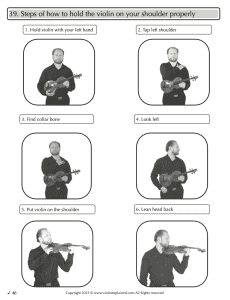
  3. Pluck away from the bridge — this is the rule for pizzicatoPictures of how to hold the violin on the shoulder properly

RULE: We pluck (pizz.) the string away from the bridge. We bow (arco) near the bridge.

Plucking Open Strings with Rhythm

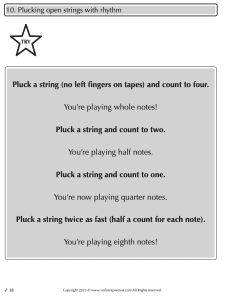
Once you can pluck each string, add rhythm. This is how you start making music — not just sounds.

Try this exercise from Learn Violin Fast — Book 1:

Exercise What You’re Playing How
Pluck a string, count to 4 Whole notes One pluck, hold for 4 beats
Pluck a string, count to 2 Half notes One pluck, hold for 2 beats
Pluck a string, count to 1 Quarter notes One pluck per beat
Pluck twice per beat Eighth notes Two quick plucks per beat

Practice this on every string. Start with G, then D, then A, then E.Instructions of how to pluck with rhythm

How to Bow Open Strings

After you’ve learned the bow hold and shoulder position (covered in Parts II and III of the book), you’ll play open strings with the bow. This is where the violin really starts to sing.

Key Rules for Bowing Open Strings:

  1. Bow placement: Halfway between the bridge and the fingerboard — this is called the highway or sounding point
  2. Bow angle: Keep the bow at 90 degrees to the string
  3. Pressure: Don’t press hard — let the weight of the bow do the work
  4. Full bows: Play from frog to tip and back

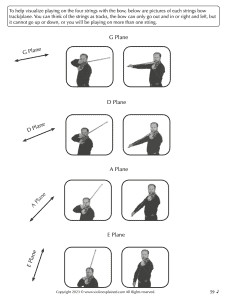
String Planes

Each string has its own plane or track. Think of the strings as railroad tracks — the bow can only go right and left (in and out), not up and down. If you move the bow up or down, you’ll accidentally play two strings at once.

  • G Plane — bow arm is highest
  • D Plane — bow arm slightly lower
  • A Plane — bow arm lower still
  • E Plane — bow arm is lowestPictures of how playing on different strings on the violin creates planes

Open Strings on the Staff

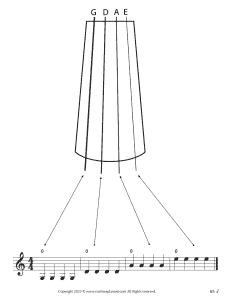
When you start reading sheet music, here’s where the open strings appear on the treble clef staff:

  • G — below the staff on a ledger line (two ledger lines below)
  • D — just below the staff (one ledger line below)
  • A — in the second space of the staff
  • E — in the fourth space of the staff

The pattern is simple: low strings = low on the staff, high strings = high on the staff.Staff and violin diagram connecting written notes with open strings of the violin

Why Open Strings Matter So Much

Open strings aren’t just a beginner exercise — they’re the foundation of everything:

  • Tuning: You tune by listening to open strings
  • Scales: Every scale starts or passes through an open string
  • Songs: Many melodies use open strings as anchor notes
  • Tone production: Open strings are the easiest way to practice good bow technique
  • Double stops: Advanced players use open strings alongside fingered notes

Even professional violinists warm up with open strings every day. Therefore, mastering them now sets you up for success at every level.

Practice Exercises

Use the Power of 10 — do each exercise 10 times:

  • Pluck each open string guitar-style and say its name (G, D, A, E)
  • Pluck each string going up (G→D→A→E) and back down (E→A→D→G)
  • Pluck whole notes on each string (count to 4)
  • Pluck quarter notes on each string (count to 1)
  • Pluck open strings on the shoulder
  • Bow each open string with full bows (frog to tip)
  • Bow open strings going up and down all four strings
  • Name the open strings from memory without looking

Get the Full Method

Open strings are just the beginning. Learn Violin Fast — Book 1 takes you from your first pluck through finger placement, reading music, scales, and 8 complete songs.

👉 Get Learn Violin Fast — Book 1 on Amazon — the complete beginner method with step-by-step diagrams, exercises, and songs.

🎬 Subscribe to Violin Explained on YouTube for video demonstrations of open string exercises and bowing technique.


Written by Sergei Panov, author of the Learn Violin Fast method book series and founder of ViolinExplained.com. Sergei has taught over 1,000 violin students and developed this method to help beginners learn as quickly and enjoyably as possible.
Posted on Leave a comment

How to Hold a Violin Bow: 6 Steps to a Perfect Bow Hold

The bow hold is the most important technique in violin playing — it controls your tone, volume, and expression. A bad bow hold leads to scratchy sound, tension, and frustration.

In Learn Violin Fast — Book 1, I break the bow hold down into simple steps that any beginner can follow. But before we pick up the bow, you need to know what you’re holding.

How Do You Hold a Violin Bow?

Place your thumb and middle finger in a circle on the bow’s frog, then add your index finger on the stick, ring finger next to the silver (ferrule), and pinky on top of the stick — all with curved, relaxed fingers.

That’s the short version. Let me walk you through every detail.

First: Know Your Bow Parts

Before learning the bow hold, you need to understand the parts of the bow and what they do. In my experience, students who understand why each part matters learn the bow hold faster.

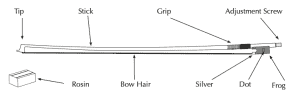
Diagram of the violin bow and it's partsParts of the Violin Bow:

  • Stick — The main part of the bow. Holds the hair and all other parts. Made from pernambuco wood (expensive), brazilwood, carbon fiber, fiberglass, or composites
  • Hair — Comes from a horse’s tail (the horses are not hurt — they simply get a tail haircut!). A typical bow has 160–200 individual hairs
  • Rosin — A solid sticky substance that coats the bow hair, allowing it to grip and vibrate the string to produce sound
  • Tip — Holds the bow hair on one end
  • Frog — Holds the bow hair on the opposite end (this is where your hand goes)
  • Adjustment screw — Tightens and loosens bow tension. Remember: righty tighty, lefty loosey
  • Silver (ferrule) — Keeps the bow hair flat in the frog. Its real name is the ferrule, but “silver” is easier to remember
  • Grip — Helps you hold the stick. Comes in leather, rubber, plastic, or silver wire winding
  • Dot — Purely decorative

How Bow Hair Makes Sound

Each bow hair has tiny scales — similar to fish scales — that hold onto the rosin. When the bow moves across the string, the rosin makes the hair stick to the string, creating vibrations. Those vibrations travel through the bridge into the body of the violin, excite the air inside, and produce a beautiful sound.

This is why you should never touch the bow hair with your fingers. Oil from your skin will coat the scales and the bow will lose its ability to grip the string.

How Tight Should the Bow Be?

There should be approximately a quarter of an inch between the bow hair and the stick when tightened for playing.

Quick test: You should be able to slide a pencil between the hair and the stick in the middle of the bow.

Important: Always loosen the bow hair when you’re done playing so it can rest and not stretch out over time.

How to Hold a Violin Bow: 6 Steps

Here is the exact method I teach in Learn Violin Fast — Book 1:

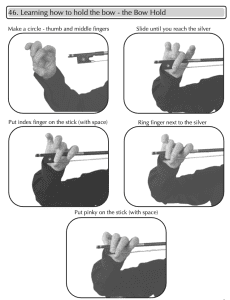
Diagram and pictures of how to make a proper violin bowhold in 6 stepsStep 1: Make a Circle with Your Thumb and Middle Finger
Touch the tips of your thumb and middle finger together to form a round “O” shape. This is the foundation of your entire bow hold. Keep it relaxed — don’t squeeze.

Step 2: Slide Until You Reach the Silver

Place this circle onto the bow at the frog and slide your fingers until your thumb reaches the silver (ferrule). Your thumb should be bent, not locked straight.

Step 3: Place Your Index Finger on the Stick

Rest your index finger on the stick, with a small space between it and the middle finger. The stick should contact your index finger between the first and second knuckle.

Step 4: Place Your Ring Finger Next to the Silver

Your ring finger goes right next to the silver, close to your middle finger. It provides support and balance.

Step 5: Place Your Pinky on Top of the Stick

Your pinky goes on top of the stick, curved and resting on its tip. This is the most important finger in the bow hold — it acts as a counterbalance, especially when playing at the tip of the bow.

Step 6: Check Your Hold

All fingers should be:

  • Curved (not flat or locked)
  • Relaxed (not squeezing)
  • Spaced (not bunched together)

Your thumb should be bent and opposite your middle finger.

The Pinky Trick That Fixes 90% of Bow Hold Problems

Here’s the secret most teachers don’t emphasize enough: your pinky is the key to the entire bow hold.

When beginners play, the bow feels heavy at the tip. The natural reaction is to squeeze harder with the thumb and index finger. However, this creates tension, a scratchy sound, and eventually pain.

The fix? Keep your pinky curved and on top of the stick. It acts as a counterweight. When your pinky is doing its job, your other fingers can stay relaxed.

If your pinky keeps collapsing flat or falling off the bow, practice this:

  1. Hold the bow vertically (tip pointing up)
  2. Balance it using only your thumb and pinky
  3. Practice tapping your other fingers on and off the stick

As a result, this builds pinky strength and awareness.

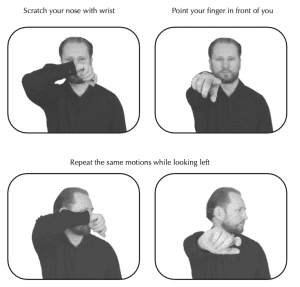
Bow Motion: The “Scratch-You” Technique

Once you have a solid bow hold, you need to learn the motion of bowing. In Learn Violin Fast, I teach a simple way to remember the bow motion:

  1. Scratch your nose with your wrist — that inward motion
  2. Point your finger in front of you — that outward motion

That’s the direction of the bow: in and out, like scratching and pointing.

Think: “Scratch — You”

First, practice these motions without the violin. Next, try them while holding the bow. Finally, apply them on the strings.

Pictures of how to properly make violin bow motion

Playing Your First Bow Strokes

Now let’s put it all together. With the violin on your shoulder and the bow in your hand:

  1. Place the bow on the string — halfway between the bridge and the fingerboard (this is called the highway or sounding point)
  2. Keep the bow at 90 degrees to the string
  3. Don’t press hard — for now, just move the bow in and out gently
  4. Play full bows — from frog to tip and back on all four strings

Key Tips for Your First Bow Strokes:

  • Bow placement matters: Stay on the highway (halfway between bridge and fingerboard)
  • 90 degrees: The bow should be perpendicular to the strings
  • Light pressure: Let the weight of the bow do the work
  • Relax your shoulders: Tell your shoulders to “chill” and keep them down
  • Think in tracks: Each string has its own plane — the bow goes right and left, not up and down

Common Bow Hold Mistakes

Mistake Fix
Flat pinky (collapsed) Curve it and place on tip — practice the vertical balance exercise
Locked/straight thumb Bend your thumb — it should be flexible
Squeezing too hard Relax — if your hand hurts, you’re gripping too tight
Index finger too close to middle Keep space between all fingers
Bow bouncing on the string Slow down, use less pressure, stay on the highway
Bow sliding toward the fingerboard Watch your contact point — keep it halfway to the bridge

Rosin: Don’t Forget This Step

Before you play, you need to rosin your bow every day. Rosin is what allows the bow hair to grip the string.

  • Press the bow hair into the rosin and slide back and forth
  • You can actually hear the bow “eat” the rosin — a slight grabbing sound
  • A few passes is enough — you don’t need a lot
  • New bows need extra rosin the first time (10–15 passes)

Practice Checklist

Use the Power of 10 — do each task 10 times to build muscle memory:

  • Practice making the bow hold circle (thumb + middle finger)
  • Form the complete bow hold with all 5 fingers
  • Vertical bow balance exercise (thumb + pinky only)
  • “Scratch-You” motion without the bow
  • “Scratch-You” motion with the bow
  • Full bow strokes on each open string (G, D, A, E)
  • Check: Is your pinky curved? Thumb bent? Shoulders relaxed?

Get the Full Method

This guide covers the bow hold basics, but Learn Violin Fast — Book 1 includes detailed photos, the complete bow parts quiz, bowing exercises on all four strings, and 8 songs to play with the bow.

👉 Get Learn Violin Fast — Book 1 on Amazon — the complete beginner method with step-by-step diagrams, exercises, and songs.

🎬 Subscribe to Violin Explained on YouTube for video demonstrations of the bow hold and bowing technique.


Written by Sergei Panov, author of the Learn Violin Fast method book series and founder of ViolinExplained.com. Sergei has taught over 1,000 violin students and developed this method to help beginners learn as quickly and enjoyably as possible.

Posted on Leave a comment

How to Hold a Violin for the First Time — The Complete Beginner’s Guide

Holding a violin correctly is the single most important skill you’ll learn as a beginner — get it right from Day 1 and everything else becomes easier.

Having taught over 500 students, I can tell you that most beginners struggle not because they lack talent, but because they try to play on the shoulder before their body is ready. In my method book Learn Violin Fast — Book 1, I teach a two-stage approach that makes holding the violin feel natural from the very first lesson.

How Do You Hold a Violin for the First Time?

Hold the violin like a guitar first to learn the basics without strain, then transition to the shoulder position once your hands are comfortable with the strings and notes.

This two-stage approach — guitar style first, shoulder style second — is the foundation of the Learn Violin Fast method. It lets you start making music immediately while your body builds the strength and muscle memory needed for the traditional shoulder position.

Stage 1: Guitar Style (Your First Days)

Before putting the violin on your shoulder, start by holding it like a guitar. This is how I begin every new student’s journey in Learn Violin Fast — Book 1.

Why Start Guitar Style?

  • You can learn to pluck the strings and produce sound right away
  • You understand how finger placement changes pitch without the stress of balancing the instrument
  • Your hands and shoulders aren’t under strain, so you can focus on learning notes and songs
  • You can learn your first songs within minutes (Hot Cross Buns, Twinkle Twinkle)

How to Hold the Violin Guitar Style:

  1. Stand up straight — good posture starts here
  2. Hold the violin with the scroll on the same side as your left hand — the neck points to your left
  3. Support the violin using your right arm — cradle the body against you
  4. Pluck each string using your thumb or index finger — say the name of each string as you pluck (G, D, A, E)

This position lets you learn all the basics — open strings, finger placement, reading music, and even your first songs — before you ever put the violin on your shoulder.

Stage 2: Holding the Violin on Your Shoulder

Once you’re comfortable with the notes and can pluck simple songs, it’s time to transition to the shoulder position. This is where most beginners get frustrated — but it doesn’t have to be hard if you understand why it feels awkward.

Why Is the Shoulder Position So Difficult?

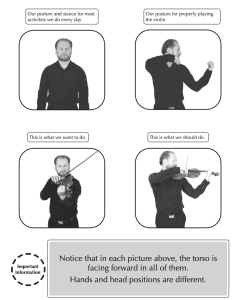
Think about what your body does all day. Your hands are typically by your sides or in front of you — below your waist. When you read, write, or type, your hands are always in front of you.

Playing the violin requires your hands to move in totally different motions and be in positions you’re simply not used to. That’s why it feels uncomfortable at first — it’s not you, it’s biology.

The Proper Violin Position:

  • The violin should be on your left shoulder
  • The bottom center of the violin rests on your left collar bone
  • The bow in the right hand is in front of your body with the hand straight
  • The left hand holds the violin over to the left side

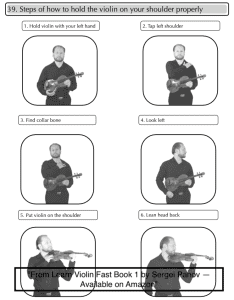
How to Hold a Violin on Your Shoulder: 6 Steps

Here is the exact step-by-step method I teach in Learn Violin Fast:

  1. Hold the violin with your left hand
  2. Tap your left shoulder — find where the violin will sit
  3. Find your collar bone — this is the anchor point
  4. Look left — turn your head to the left
  5. Put the violin on the shoulder — rest it on the collar bone
  6. Lean your head back — let the chin rest support the weight

Pro tip: Your left shoulder will want to squeeze up. Train your shoulder to relax and keep it down. This is the #1 mistake I see beginners make — a tense, raised shoulder leads to pain and bad habits.

Do You Need a Shoulder Rest or Sponge?

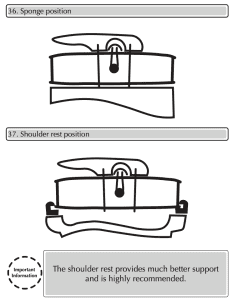
To help support the violin on your shoulder, you’ll use either a sponge or a shoulder rest.

Sponge Method:

  • Attach two small rubber bands (or one large one) to the violin’s end button and corners of the C bout
  • Place the sponge between the violin and your shoulder

Shoulder Rest Method:

  • Simply clip the shoulder rest onto the bottom of the violin
  • The shoulder rest provides much better support and is highly recommended

Left Hand Placement

With the violin on your shoulder, your left hand supports the neck of the violin:

  • Your knuckle and top of the thumb support the violin neck
  • Keep a space at the bottom of your hand between the index finger and knuckle
  • Your left wrist should be at 180 degrees between the elbow and hand — a straight line
  • Do not bend your wrist in or out, and don’t let it touch the neck of the violin

This is what we call keeping your left hand “open.”

Common Mistakes When Holding a Violin

Based on my experience teaching hundreds of students, here are the most common mistakes:

Mistake Fix
Raised left shoulder (tension) Consciously relax and drop your shoulder down
Violin sliding off shoulder Use a shoulder rest (not just a sponge)
Wrist bent inward touching the neck Keep wrist straight — 180° from elbow to hand
Holding violin in front of body Move it to the left, over your left shoulder
Gripping too hard with chin Rest your jaw lightly on the chin rest — don’t clamp
Trying shoulder position too soon Start guitar style first, build comfort with notes

Practice Checklist

Use the Power of 10 — do each task 10 times to build muscle memory:

  • Hold violin guitar style and pluck each open string (G, D, A, E)
  • Attach shoulder rest and place violin on shoulder
  • Follow the 6 steps to proper shoulder position
  • Check left hand placement (open wrist, thumb position)
  • Pluck open strings on the shoulder
  • Play Hot Cross Buns guitar style, then on the shoulder

Get the Full Method

This guide covers the basics, but there’s so much more in the book — finger placement charts, note-by-note exercises, and 8 songs to learn in Book 1 alone.

👉 Get Learn Violin Fast — Book 1 on Amazon — the complete beginner method with step-by-step diagrams, exercises, and songs.

🎬 Subscribe to Violin Explained on YouTube for video demonstrations of everything in this guide.


Written by Sergei Panov, author of the Learn Violin Fast method book series and founder of ViolinExplained.com. Sergei has taught over 500 violin students and developed this method to help beginners learn as quickly and enjoyably as possible.