On the violin, your ear is the boss. There are no frets and no keys telling you where the note is — so your ear has to tell your finger whether the note was too high, too low, or just right. The good news: you can train that ear in a few minutes a day, without sitting through a music-theory marathon.
If you teach, this is the part that always feels impossible — most ensembles simply don’t have the time to teach detailed theory. But you don’t need a whole unit on it. You need a small handful of ideas and a way to practice them. In Learn Violin Fast — Book 2, I lean on the ear constantly for intonation. Here’s the quick path I use to teach students to name intervals and become better listeners.
What Is an Interval?
An interval is simply the distance between two notes. That’s the whole idea. If you can hear two notes and know how far apart they are, you can find them on your instrument without guessing.
The fastest way to see intervals is to draw a scale using just the letter names, from the bottom note up. Here’s a D major scale:
D E F# G A B C# D
Now you can picture a scale climbing from the bottom note — its tonic — all the way up to the top tonic. The tonic is home base.
Number the Notes to Name the Interval
Here’s the trick that connects notes to interval sizes: number the scale.
| Note | Number |
|---|---|
| D | 1 (tonic) |
| E | 2 |
| F# | 3 |
| G | 4 |
| A | 5 |
| B | 6 |
| C# | 7 |
| D | 8 (octave) |
To name an interval, you count the distance between the notes — including both the first and the second note. So:
- D to E is a 2nd (notes 1 and 2)
- D to F# is a 3rd (1, 2, 3)
- D to G is a 4th (1, 2, 3, 4)
- D to A is a 5th (1, 2, 3, 4, 5)
That’s it. The name of an interval is just how many letters you count from the bottom note to the top, counting both ends.
Connect Intervals to Your Strings
Here’s the part string players have a head start on: the violin, viola, and cello are all tuned in fifths.
Look at your open strings — G, D, A, E. From D to A is a 5th. From G to D is a 5th. You already own the sound of a perfect fifth, because it’s the sound of two open strings ringing together. Use it as your anchor.
| From → To | Interval |
|---|---|
| G → D (open strings) | Perfect 5th |
| D → A (open strings) | Perfect 5th |
| A → E (open strings) | Perfect 5th |
Major and Minor Thirds Live on Your Tapes
Thirds are where ear training gets useful fast, because the difference between a major third and a minor third is the difference between “happy” and “sad” — and you can feel it under your fingers.
A third spans two letters of the scale, but it comes in two sizes:
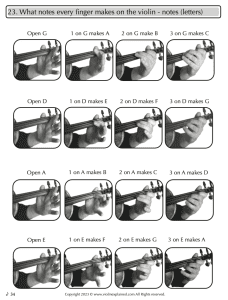
- A major 3rd is two whole steps. From open D up to F# on the second tape of the D string is a major third — bright and happy.
- A minor 3rd is a step and a half. From open D up to F natural — between the first and second tape — is a minor third — darker and sadder.
| Play on the D string | Top note | Interval | Sound |
|---|---|---|---|
| Open D → 2nd tape | F# | Major 3rd | Bright / happy |
| Open D → between 1st & 2nd tape | F natural | Minor 3rd | Dark / sad |
Play those two back to back a few times. That tiny slide of the finger — about half a step — is the entire difference between major and minor. Once your ear locks onto it, you start hearing it everywhere.
How to Actually Train Your Ear
Knowing the names is step one. Hearing them in real time is the skill — and that only comes from reps with immediate feedback. That feedback loop is everything: if you guess wrong and find out right away, your ear corrects itself fast. If you guess wrong and never know, you just rehearse the mistake.
This is exactly what I built the ear training exercises at NoteFest.com to do. You listen to two notes and answer — and it tells you instantly whether you were right. Here’s the order I’d take a student (or yourself) through:
| Step | What you practice | The question |
|---|---|---|
| 1. Direction | Higher, lower, or the same | “Is the second note higher, lower, or the same as the first?” |
| 2. Seconds | Minor vs major 2nds | “Which second did you hear?” |
| 3. Thirds | Minor vs major 3rds | “Happy third or sad third?” |
| 4. Fourths & Fifths | Perfect 4ths and 5ths | “Is it a fourth or that open-string fifth?” |
| 5. Sixths & Sevenths | The wider intervals | “How far apart now?” |
| 6. The Challenge | Every interval, unison to octave | “Name it — all of them, in any order” |
Start with plain higher / lower / same. It sounds almost too simple, but it builds the foundation — you’re teaching the ear to notice direction before it worries about distance. Get a few wrong, get the instant correction, and move on. Then step up to seconds, thirds, fourths and fifths, sixths and sevenths, and finally the full challenge that mixes everything from unison all the way to the octave.
And keep making the connection back to your instrument. When you drill minor vs major thirds in the exercise, remember: that is D to F# versus D to F natural on your D string. The screen and the fingerboard are teaching the same thing.
Watch It in 60 Seconds
Here’s the whole idea — counting intervals, connecting them to your strings, and practicing them — in a short video:
https://www.youtube.com/watch?v=4DoBNE7e5nI
👉 Watch “How to teach students to be better listeners” on YouTube
For Teachers: The Five-Minute Version
If you run an ensemble and theory time is scarce, you don’t need a unit on this. You need five minutes and a routine:
- Anchor on the open-string fifth. Have the section play two open strings — that ringing sound is a perfect fifth.
- Show one contrast. Major third (D→F#) vs minor third (D→F natural) on the D string. Happy vs sad. That’s the lesson.
- Send them to drill it. Point students to the ear training exercises so the reps happen outside of class, with feedback you don’t have to give one at a time.
- Spot-check by ear. Play two notes; ask the room “higher or lower?” then “major or minor?” Thirty seconds, real engagement.
Ear Training Tips
| Tip | Why It Works |
|---|---|
| Sing the two notes before you play them | Your voice can’t hide — it reveals whether you actually hear the interval |
| Use open strings as reference points | The perfect fifth is free and always in tune — anchor everything to it |
| Drill in short bursts | Five focused minutes beats one long session — the ear fatigues fast |
| Always get immediate feedback | Right-or-wrong on the spot is what rewires your ear; guessing in the dark doesn’t |
| Connect every interval to a finger | “Major third = F# on the second tape” makes the sound physical and memorable |
| Use the Power of 10 | Ten reps of an interval per session builds recognition into reflex |
Practice Challenge
- Direction: Have someone play two notes — call out higher, lower, or same. 10 times.
- Thirds on the D string: Play D→F# (major) and D→F natural (minor) back to back until you can hear the difference with your eyes closed.
- Name the fifth: Play any two open strings and confirm out loud — “that’s a fifth.”
- Go digital: Run the higher/lower exercise, then the thirds challenge, at NoteFest.com. Beat your last score.
- The full challenge: Once seconds through sevenths feel solid, try the all-intervals challenge from unison to octave.
Keep Building Your Ear
A trained ear is what lets you play in tune without tapes, learn music faster, and actually enjoy the sound you’re making. In Learn Violin Fast — Book 2, I show how the ear and intonation work together — including forced vibration, the technique that lets your violin physically tell you when you’re in tune.
👉 Get Learn Violin Fast — Book 2 on Amazon — master intonation, bow control, and sound production with step-by-step exercises.
🎧 Practice intervals free at NoteFest.com — ear training exercises with instant feedback, from higher/lower all the way to the full interval challenge.
🎬 Subscribe to Violin Explained on YouTube for short, practical violin lessons.
Written by Sergei Panov, author of the Learn Violin Fast method book series and founder of ViolinExplained.com. Sergei has taught over 1,000 violin students and developed this method to help beginners learn as quickly and enjoyably as possible.

 How Often Should You Rosin Your Bow?
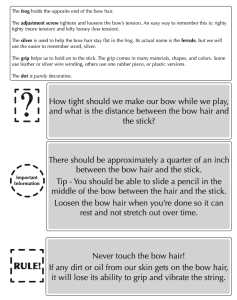 Always Loosen the Bow When You’re Done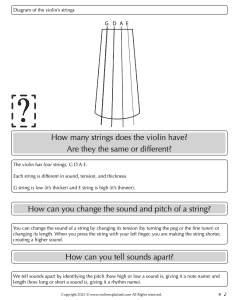
 Try this right now: