
Your child is bright. They learn quickly, ask good questions, and can memorize the words to every song they love. But put a page of sheet music in front of them, and something breaks down. They squint at the staff, count lines with their finger, and still play the wrong note. You’ve explained it a dozen times. Their teacher has explained it a dozen more. And yet.
If this sounds familiar, you are not alone—and more importantly, you are not dealing with a child who lacks musical ability. You are dealing with a child who has not yet been given the right kind of practice for a very specific cognitive skill. Decades of research on music reading, visual perception, and learning tell us exactly why kids struggle here, and that understanding points toward something practical you can do about it.
The Three Real Reasons Kids Struggle to Read Music
1. Reading Music Is a Specialized Spatial Task—And We Treat It Like It Isn’t
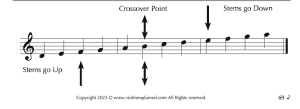
When a child reads the word cat, the letters themselves carry meaning. The shape of a C is always a C. But when a child reads a musical note, the notehead itself is almost meaningless. What matters is precisely where it sits on a five-line staff—whether it is on a line, between lines, and which specific line or space. A note sitting one millimeter higher or lower is an entirely different pitch.
Researchers studying music reading have long recognized that pitch identification depends primarily on the spatial position of notes on the staff (Sloboda, 1978; Gudmundsdottir, 2010). This is a specialized spatial processing skill—one that requires the visual system to encode fine-grained vertical position with high accuracy. Studies tracking the eye movements of readers confirm that skilled musicians fixate differently than beginners: they have learned to extract positional information efficiently, while beginners spend far more time locating and re-checking individual notes (Drai-Zerbib, Baccino, & Bigand, 2012).
The problem is that spatial processing of this kind does not come naturally to most children. We don’t use it in everyday visual tasks. Letters don’t change meaning based on their height on a line. Numbers don’t shift value based on which row they occupy. Music notation asks the visual system to do something genuinely unusual—and it takes dedicated, targeted practice to build that ability.
2. Visual Crowding Makes Every Note Harder to See
Here’s something that surprises most parents and teachers: even if a child can identify a note perfectly when it’s shown on its own, placing that same note inside a measure of sheet music makes it significantly harder to recognize. This isn’t a concentration problem. It’s a well-documented perceptual phenomenon called visual crowding.
Crowding refers to the way our visual system struggles to identify objects when other objects are nearby. First described systematically by Bouma (1970), crowding has since been established as a fundamental constraint on conscious visual perception: objects in the presence of neighboring “flankers” are harder to identify, even when the target itself is well within our visual acuity (Whitney & Levi, 2011).
Take a look at a page of real orchestral sheet music:
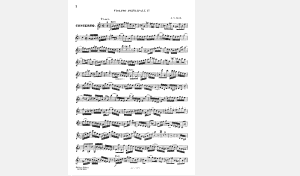 In sheet music like this, every note is surrounded by flankers—the staff lines above and below, neighboring noteheads, stems, barlines, and dynamic markings. For a beginner, this visual density is not just aesthetically busy; it actively degrades their ability to identify any single note. Studies examining expert versus novice music readers find that experts show much smaller crowding effects than novices, suggesting that visual expertise in music reading involves learning to suppress irrelevant flanking information (see Gauthier & Tarr, 2002, on visual expertise and perceptual learning more broadly). Beginners have not yet built that perceptual filter. Every note they try to read is being drowned out by everything around it.
3. Cognitive Overload Stops Learning Before It Starts
Now add one more layer. A beginning music student sitting at their instrument, looking at a page of music, is not just identifying notes. They are simultaneously:
- Locating the note’s position on the staff
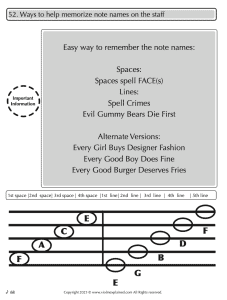
- Naming the note (remembering which letter name corresponds to which line or space)
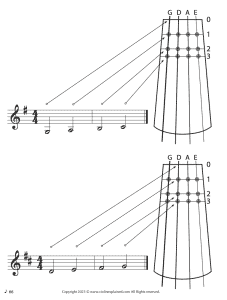
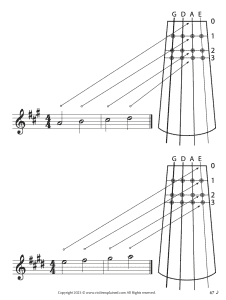
- Translating that name into a physical action on their instrument
- Keeping their posture, breath, or bow hold in mind
- Tracking the rhythm and tempo
- Watching for the teacher’s cues
Cognitive load theory, developed by Sweller (1988), holds that working memory has a strict capacity limit. When the number of elements a learner must process simultaneously exceeds that limit, learning degrades sharply. For music beginners, the very first step in the chain—simply identifying where on the staff the note sits—is already demanding enough to consume significant working memory resources. Every additional demand layered on top compounds the problem.
The result is that children are asked to perform a complex, multi-step cognitive task before they have automated even the foundational step. It’s the equivalent of asking someone to compose a sentence in a foreign language before they can reliably recognize the letters of its alphabet.
Why Traditional Teaching Doesn’t Fix This
Most music curricula—and most well-meaning parents and teachers—approach notation by putting children directly in front of full sheet music and drilling repetition. The assumption is that if kids practice reading music enough, they will naturally develop fluency over time. And eventually, many of them do. But this approach sidesteps the actual bottleneck.
Full sheet music provides no relief from visual crowding. It does not reduce cognitive load—it maximizes it. And it never isolates the foundational spatial recognition skill long enough for a child to actually build it. Practicing in this environment is a bit like learning to identify individual letters by reading full paragraphs of text in a cluttered, visually noisy font. Progress happens, but slowly, and with a lot of frustration along the way.
The children who struggle most are often those with the highest cognitive load to begin with—kids managing a new instrument, kids who are auditory learners being asked to work visually, kids who haven’t had enough time to let any part of the skill become automatic.
The Research-Backed Fix: Isolate the Skill First
The solution that emerges from this research is straightforward, even if it’s underused in practice: remove the visual crowding and reduce the cognitive load before adding them back.
If the core challenge is identifying the spatial position of a note on the staff, then children need practice doing exactly that—and nothing else. A single note, displayed with its staff, no neighboring notes, no distractors, no simultaneous demands to produce sound on an instrument. Just: Is this note on a line or in a space? Which one?
This kind of isolated, targeted practice allows the visual system to build the spatial processing skill directly. Once a child can reliably and quickly identify where a note sits on the staff in a low-noise environment, they have built the cognitive foundation that makes everything else easier. Adding instrument technique, rhythm, and full piece reading on top of that foundation is a fundamentally different experience than trying to build the foundation and play the piece simultaneously.
A Tool Built Around This Idea
NoteFest.com is a game designed specifically around this research. Its foundational lesson presents one note at a time—a single notehead on a staff, isolated, with no neighboring notes competing for visual attention. The child’s task is simply to identify the note: which line or space does it occupy?
Try the foundational Lines & Spaces lesson — free, no sign-up:
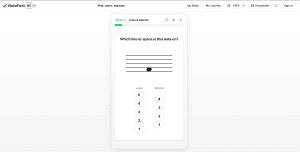 This isn’t a simplified version of music reading that kids will have to “unlearn” later. It’s practice at the exact perceptual skill that sheet music demands, delivered in conditions that actually let the skill develop. The game builds fluency with spatial note recognition before layering on other cognitive demands, which means kids arrive at full sheet music with that first step already automatic.
For parents working with kids at home, or teachers looking for focused supplemental practice, NoteFest gives students the kind of deliberate, targeted repetition that traditional sheet music practice rarely provides.
Building Confidence One Step at a Time
The children who give up on music notation are rarely children who lack musical ability. They are children who were asked to run before they could walk—to process full sheet music before they had built fluency with the visual foundation it rests on.
Understanding the spatial demands of music reading, the reality of visual crowding, and the limits of working memory doesn’t just explain why kids struggle. It tells us exactly where to focus our help. Isolate the skill. Reduce the noise. Build the foundation first. When children succeed at that foundational step, the rest of the learning stack becomes far more accessible—and far more enjoyable.
References
Bouma, H. (1970). Interaction effects in parafoveal letter recognition. Nature, 226, 177–178.
Drai-Zerbib, V., Baccino, T., & Bigand, E. (2012). Sight-reading expertise: Cross-domain transfer to melodic dictation. Learning and Instruction, 22(2), 85–96.
Gauthier, I., & Tarr, M. J. (2002). Unraveling mechanisms for expert object recognition: Bridging brain activity and behavior. Journal of Experimental Psychology: Human Perception and Performance, 28(2), 431–446.
Gudmundsdottir, H. R. (2010). Advances in music-reading research. Music Education Research, 12(4), 331–338.
Sloboda, J. A. (1978). The psychology of music reading. Psychology of Music, 6(2), 3–20.
Sweller, J. (1988). Cognitive load during problem solving: Effects on learning. Cognitive Science, 12(2), 257–285.
Whitney, D., & Levi, D. M. (2011). Visual crowding: A fundamental limit on conscious perception and object recognition. Trends in Cognitive Sciences, 15(4), 160–168.
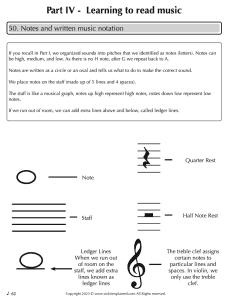
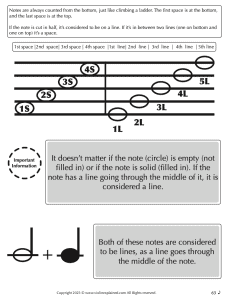
 Visual Spacing Trick
 Common Mistakes When Reading Sheet Music